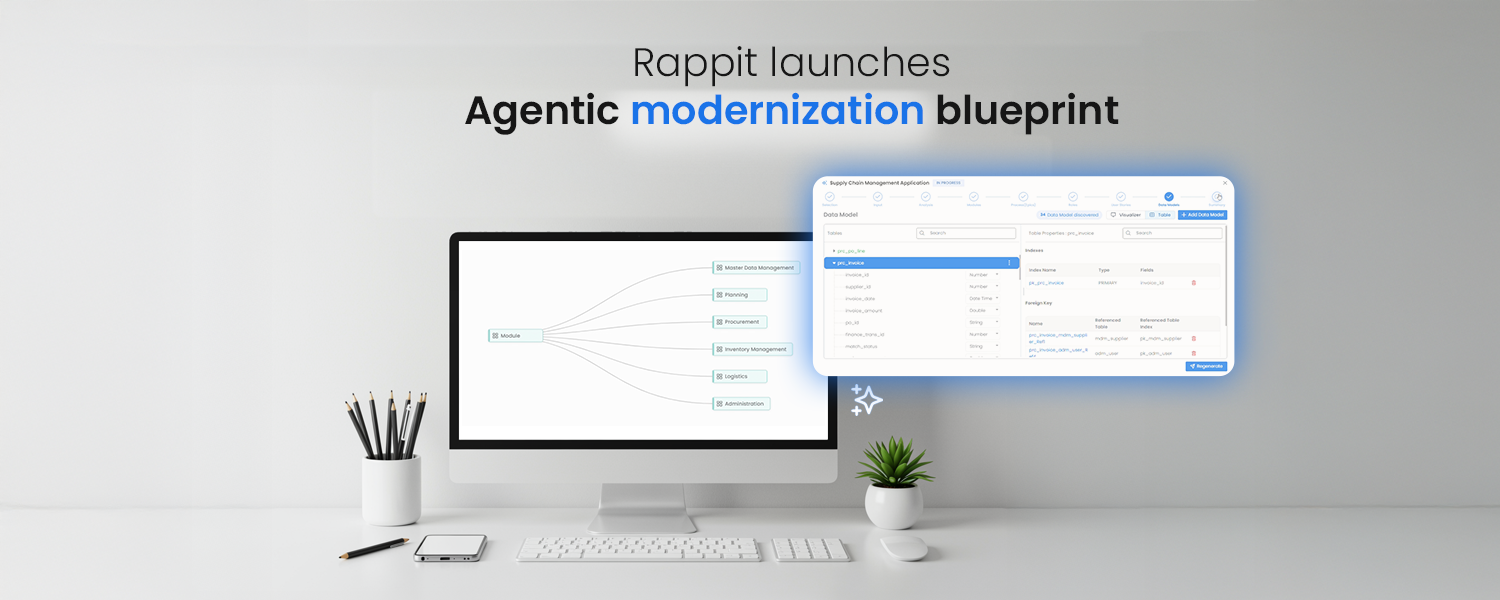
Rappit launches Agentic modernization blueprint: breakthrough in modernizing legacy systems
Delivers 50–70% time savings by automating reverse-engineering of legacy and core systems
Rappit, an AI-led application development platform provider, today announced Agentic modernization blueprint, a breakthrough capability that uses Agentic AI to transform legacy and core system assets into enterprise-ready, cloud-native applications.
Traditional modernization efforts face prohibitive costs, multiyear timelines, and significant disruption to business operations. One of the biggest drivers of this paralysis is the “discovery gap”, understanding what a legacy system actually does, particularly when documentation is incomplete, outdated, or inaccessible. This discovery phase alone can take months, delaying time-to-value and stalling transformation initiatives before they gain momentum.
Rappit’s Agentic modernization blueprint addresses this head-on by using agentic AI to extract the intent and business functional use case of the application from legacy systems, enabling organizations to rebuild on a modern, cloud-native architecture designed for AI and continuous evolution. Organizations rebuild with trusted, secure code, not just migrated technical debt.
Business impact: IT teams report 50–70% time savings on application blueprint development. By automating the most time-consuming phase, reverse-engineering legacy business functional use cases, Rappit enables organizations to focus on innovation and value delivery, rather than reconstruction.
Agentic modernization blueprint: How Rappit accelerates and de-risks modernization
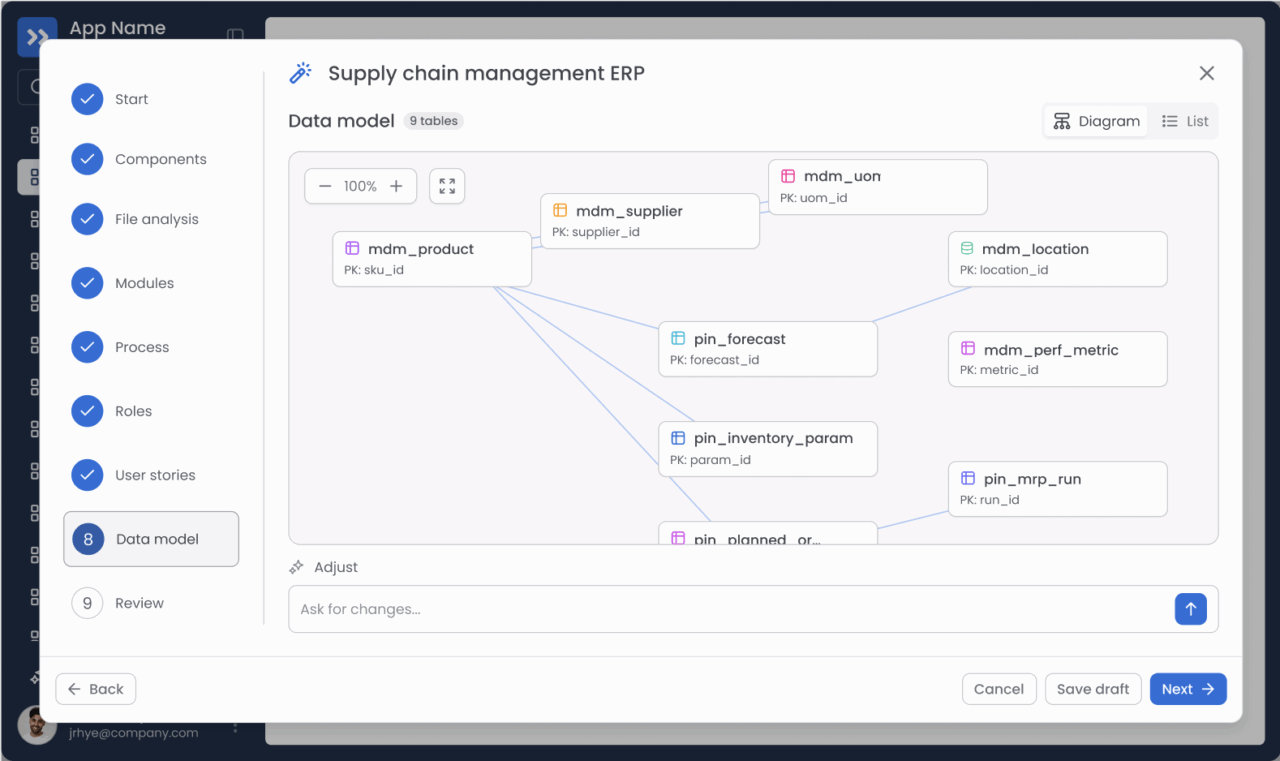
Agentic modernization blueprint leverages Retrieval-Augmented Generation (RAG), using Google Cloud’s industry-leading AI technologies, Vertex AI and Gemini models, to intelligently analyze legacy assets (functional application documentation in PDF, and application screenshots). Agentic AI automatically generates model artifacts and application components, including data models, user roles, user stories and page layouts, eventually generating the entire application.
While traditional “code and load” approaches simply transport your technical debt into a new environment, Agentic modernization blueprint extracts the intent and functional use case behind your legacy systems with precision, enabling you to rebuild on modern, cloud-native architecture without carrying forward decades of technical baggage.
The breakthrough
The agentic modernization blueprint doesn’t just modernize systems; it enables true business process re-engineering and modernization alongside them. System modernization without process reimagination is incomplete; modernizing your technology while keeping 20-year old workflows intact is like upgrading an engine without redesigning the vehicle around it. Agentic modernization blueprint aligns both transformations, enabling your team to rebuild core systems and reimagine the processes they support.
The result
Truly future-ready enterprise applications built on modern, cloud-native architecture without the baggage of outdated technology or processes.
Key capabilities include:
- AI-discovered models from legacy assets. Automatically generates roles, data model tables, user stories, and pages from legacy inputs.
- Business and IT refinement before generation. Easily adjust AI-discovered models to reflect actual business requirements before components are generated.
- AI-powered reusability via vector indexing for incremental suggestions across the development lifecycle.
- Enterprise-grade output. Production-ready components structured for cloud-native, microservices-based deployment.
Business impact: IT teams report 50–70% time savings on application blueprint development. By automating the most time-consuming phase, reverse-engineering legacy business functional use cases, Rappit enables organizations to focus on innovation and value delivery, rather than reconstruction.
“Legacy core systems, whether AS/400 or custom ERPs, were never designed to evolve at the speed business demands today,” said Ardjan Baan, CEO of Rappit. “With Agentic modernization blueprint, enterprises can now accelerate legacy modernization with minimal disruption to critical operations. This isn’t about moving technical debt to a new platform, it’s about empowering organizations to reimagine and replace outdated systems entirely. Companies can set the foundation for AI use-cases in that the newly developed apps are AI-ready and the legacy silos are no longer holding them back.”
Jan-Willem van Setten, Enterprise Architect, Hunkemöller, comments: “Rappit’s unique AI-led legacy modernization capabilities enabled us to re-imagine and rebuild a custom enterprise application in months. This delivered business continuity for over 850 stores.”
To learn more about Hunkemoller’s transformation, watch the full webinar here.
What’s next: Expanding the AI-led roadmap
Rappit’s Agentic modernization blueprint release is part of a broader vision for AI-led application development. Later this year, Rappit will introduce additional legacy modernization capabilities. Together with Rappit, organizations will be able to use source code as input, using AI to transform source into a requirements document. This will further enable organizations to capture and preserve the unique business processes and proprietary logic embedded in custom legacy core systems, translating decades of accumulated business knowledge into modern models and executable workflows.