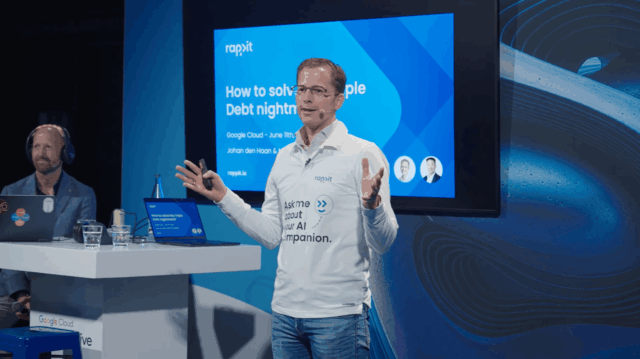
Are you moving too fast? The hidden cost of cognitive debt with AI coding tools

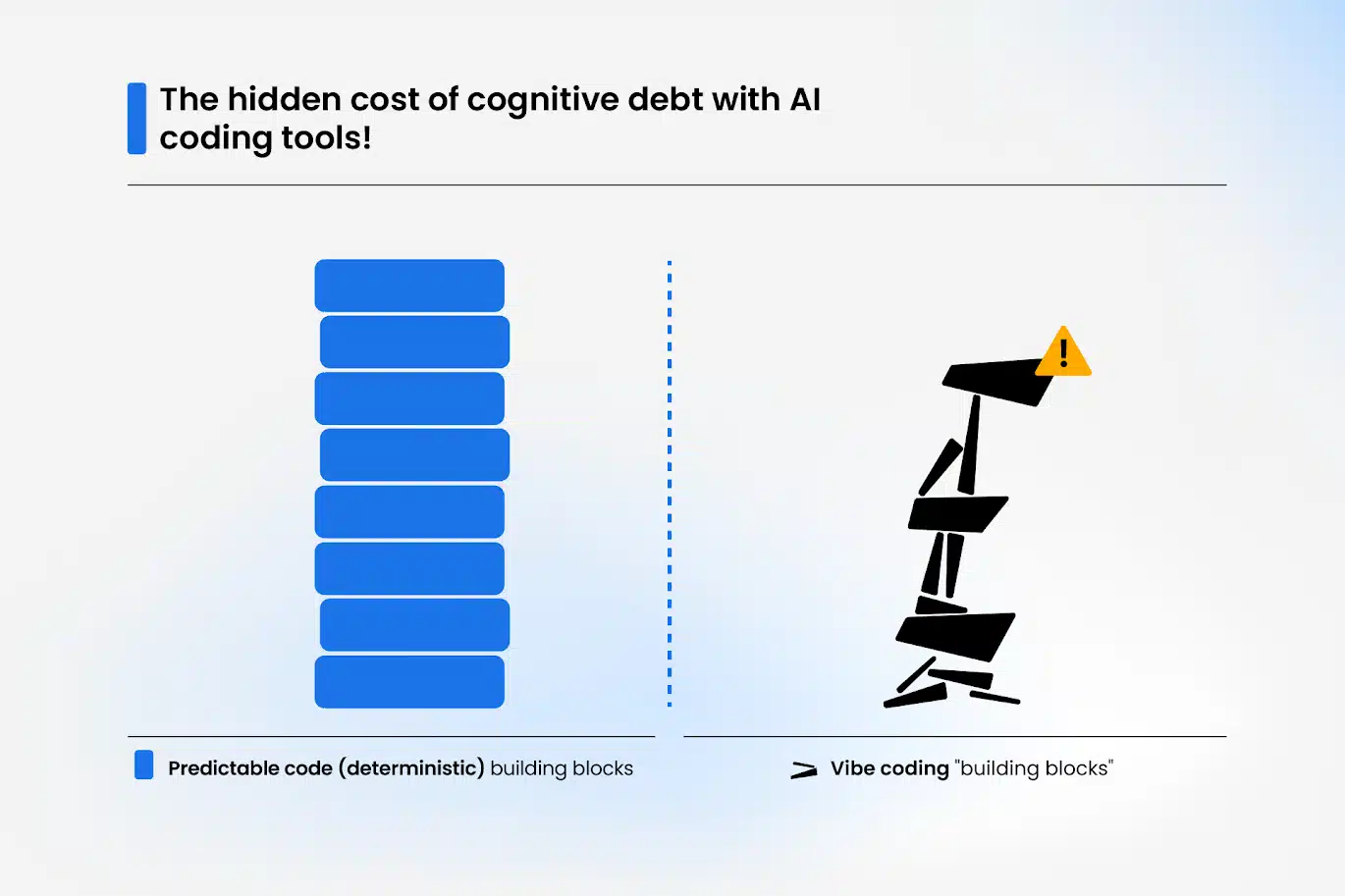
We are living through the fastest acceleration in software development the industry has ever seen. With LLM models from leaders like Google and Anthropic, developers can now describe what they want in natural language and receive working code in seconds. This shift, often called vibe coding, is redefining how software gets built.
It’s powerful. It’s exciting. And at small scale, in the hands of experienced developers, it can be transformative.
But at enterprise scale, and for core enterprise system development, like an ERP, TMS or WMS, it introduces new risks that most enterprises are not equipped to manage.
The new bottleneck
Do teams actually understand the applications they’re building with AI code generation, and the decisions behind them? As AI accelerates development, this gap is widening fast. Today, a significant share of code is AI-generated and the vast majority of developers are using AI tools, with reported productivity gains of 20% or more, yet nearly half of developers still don’t fully trust the code these tools produce.
At the same time, studies show AI-generated code can introduce security issues and that developers often overestimate their effectiveness when using AI, creating a false sense of confidence. The result is a structural imbalance: code output is scaling rapidly, but human understanding, review, and validation are not keeping pace. In this new world, code is no longer the bottleneck, understanding is.
Why we need a triple debt model
A new way of thinking is required, one that expands beyond technical debt to account for additional risks. In a recently published paper (“From Technical Debt to Cognitive and Intent Debt: Rethinking Software Health in the Age of AI”) the authors argue that as AI accelerates software development, our traditional focus on technical debt is no longer sufficient. AI actually amplifies two hidden, equally dangerous risks: intent debt and cognitive debt. To address this, the authors introduce the “Triple Debt Model”.
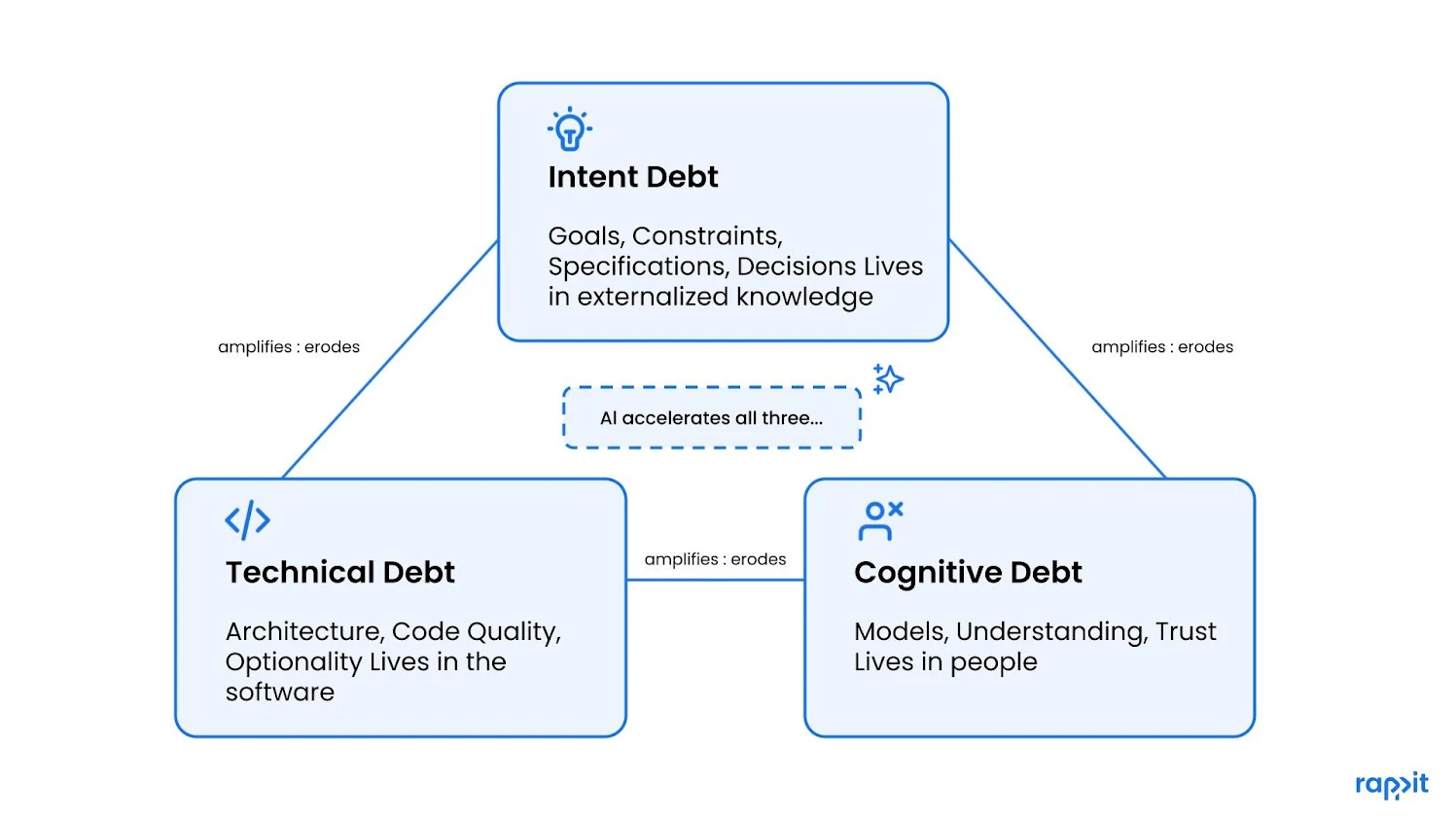
Source: “From Technical Debt to Cognitive and Intent Debt: Rethinking Software Health in the Age of AI” (Cornell University)
Cognitive debt
The erosion of a development team’s shared understanding and mental models of a system.
AI accelerates code generation faster than understanding can be built. When developers write code manually, they form an intuitive mental model. With AI-generated code, that model is often incomplete, or missing entirely.
Intent debt
The loss of the original goals, design rationale, and constraints behind the software.
Systems are not just what they do, they are why they exist. Without clearly documented intent, both humans and AI agents lack the context needed to safely evolve them.
Technical debt
The accumulation of shortcuts, inconsistencies, and suboptimal design decisions that make systems harder to change and maintain.
As AI accelerates code generation, technical debt can scale faster and hide more easily. Code may look correct, but without careful review and architectural discipline, it can introduce fragmentation and long-term complexity that makes systems brittle and difficult to maintain.
Together:
- Technical debt makes systems harder to change
- Cognitive debt makes systems harder to understand
- Intent debt makes it harder to know what the system is actually for and why
From developer efficiency to enterprise risk
Cognitive debt is not new, but vibe coding turns it from an exception into the default. In the past, knowledge gaps appeared when a key developer left and a new team inherited unfamiliar code. That was a contained problem. Now imagine that scenario across every team, every sprint.
At enterprise scale, particularly when building and evolving core systems, this becomes more than a productivity issue, it becomes a governance and security risk.
When cognitive and intent debt accumulate, enterprises face real consequences:
- Increased security vulnerabilities due to unreviewed or misunderstood code
- Compliance risks from missing auditability or data controls
- Reduced maintainability, undoing initial productivity gains
The path forward
AI-speed without structure and human oversight falls short to deliver enterprise ready software. And without explicitly documented rules (intent), AI agents lack the guardrails needed for safe, accurate future modifications.
To make agentic application development viable at enterprise scale, enterprises need enablers and guardrails:
- Capture intent: Document system purpose, constraints, and decisions in AI- and human-readable formats. This reduces intent debt and enables better collaboration with AI agents
- Embed non-functional requirements: Bake security and compliance into the development lifecycle, not as afterthoughts.
- Keep humans in the loop: AI output should not bypass human review. If anything, they demand more rigor, not less.
AI is removing the friction from software development, but that friction was never just inefficiency. It was where understanding was built, decisions were challenged, and core enterprise systems became resilient. As we automate more of the “how”, enterprises must double down on the “why”.
Because when code becomes abundant, understanding becomes the true constraint, and the real competitive advantage.
The new way to build is here!
You might also like…
How to solve the triple debt nightmare in software engineering
As AI accelerates code generation, the gap between what humans can validate for security and maintainability is widening. This shifts the enterprise challenge from simple technical debt into a triple debt crisis: technical, cognitive, and intent debt.