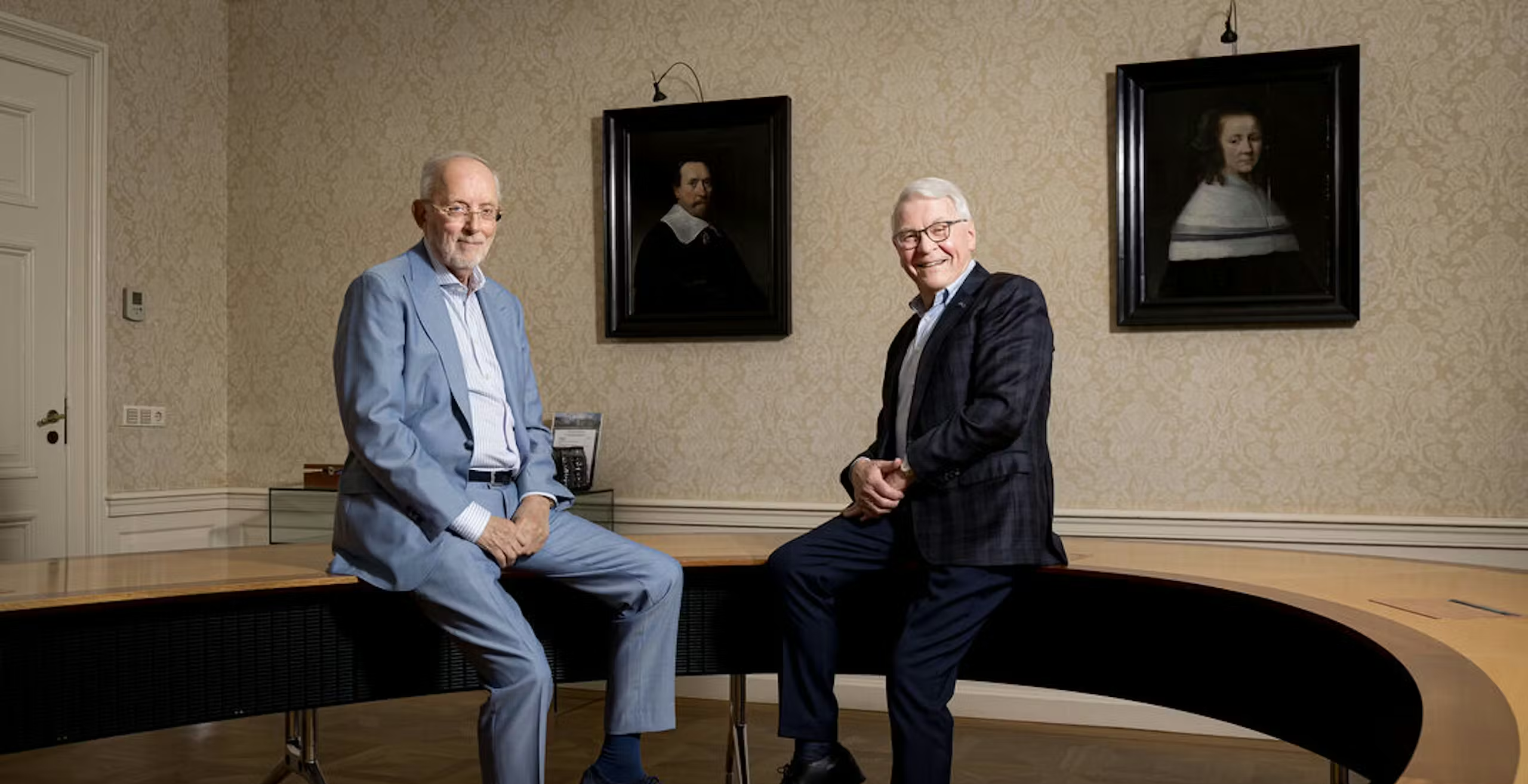
IT Icons Baan and Nederlof: “Many software companies are stealing their customers’ profits”
This interview was written and published by the Dutch financial newspaper Financieele Dagblad (FD) on May 14, 2026.
For the original interview in Dutch, click here.
Technology entrepreneurs Jan Baan and Ad Nederlof have collectively spent more than a century at the top of the Dutch and international IT industry. Both are captivated by artificial intelligence (AI), the technology that is turning “their” industry upside down. And they welcome the disruption.
Since the beginning of this year, software companies have been under heavy pressure. Hundreds of billions of euros in market value have been wiped out worldwide. Investors fear that AI will undermine the business model of this massive industry. If anyone can use AI to build custom software, what role will standard software packages from companies like SAP, Salesforce, and thousands of other large and small vendors still play?
Jan Baan and Ad Nederlof have devoted their entire careers to the IT industry. In the 1990s, Baan built Baan Company into one of the world’s largest enterprise software firms before it spectacularly declined in 2000. Nederlof rose through the ranks at Oracle before becoming CEO of Genesys, a Nasdaq-listed, multi-billion-dollar customer experience software company. Baan recently celebrated his 80th birthday, while Nederlof is battling a serious lung disease, and is doing everything possible to reach that milestone later this year in the best health he can.
Swinging the wrecking ball
Baan and Nederlof witnessed the rise and fall of the dot-com bubble around the turn of the millennium, the transition to cloud computing, and now perhaps the most profound transformation of all: the rise of AI. Both remain actively involved almost every day in their family businesses, which operate in the software industry and employ hundreds of people. Recently, they developed a product together for the first time: software for sustainability reporting.
You might expect the two to watch the so-called “SaaS-pocalypse” (SaaS stands for Software as a Service) with concern and defend “their” industry. But the opposite is true. They both believe the software industry has passed its peak. Baan, in particular, is outspoken. As far as he is concerned, it is time to swing the wrecking ball. For decades, he says, the IT industry has made itself indispensable by deliberately making its products unnecessarily complex.
According to him, that complexity makes customers dependent and drives up software prices unnecessarily. “You end up with a beautiful manufacturing company generating €1 billion in revenue that isn’t even worth €1 billion on the stock market, while the IT company supplying its software, with the same revenue, is valued at €20 billion.” In his view, that imbalance is wrong. “The manufacturing company’s profits are being stolen by the toolmaker.”
Value is shifting
Baan hopes AI will restore that balance. He compares today’s software developer to someone still digging with a shovel while excavators have long since been invented. Value, he says, is shifting away from writing code toward understanding business processes. The people who will make money in IT tomorrow won’t be the best programmers, they will be the ones who best understand how an organization works and can translate that into a customized solution.
That would be a very different type of company from the average software vendor today, whose goal is to sell a generic product to as many customers as possible. But these veterans are hardly afraid of change, they’ve experienced it many times before.
“The Oracle I worked for in the 1990s is incomparable to the Oracle of today,” says Nederlof. “If I had to sell the products I sold back then today, I’d be bankrupt within a week. But Oracle reinvented itself, just as Apple did. When a technological tsunami like this arrives, that’s when things get exciting.”
Business case
The entrepreneurs have known each other for decades, though their relationship remained largely professional for many years. Back when Baan Company was conquering the world and Nederlof was CEO of Genesys, they shared an investor and occasionally crossed paths. Only a few years ago did they really get to know, and appreciate, each other personally.
Nederlof: “Now that we’re getting older, you sometimes find yourself saying about people you’ve met: why didn’t we do this or that together back then?”
Baan: “That was your modesty.”
Nederlof: “Fortunately, it’s not too late.”
They eventually began working together a few years ago. Tangelo, one of the companies within Vanad, Nederlof’s software group, identified a business opportunity. The company already provided software for annual reports, but customers struggled with the sustainability sections. Unlike financial figures, sustainability information is often scattered across different departments and stored in different formats and files. That makes producing a consistent report both complicated and labor-intensive. Surely there had to be a better way.
Now that we’re getting older, you sometimes find yourself saying: why didn’t we do this or that together back then?
Ad Nederlof
A joint venture
The arrival of new sustainability reporting regulations created urgency. This time, Nederlof did think of Baan. During a dinner at Nederlof’s castle near Putten, they developed the concept. They then brought together their sons, both CEOs of their respective family businesses. The result is now a joint Nederlof-Baan creation.
And, Baan argues, it is fundamentally different from traditional software. The octogenarian launches into an enthusiastic, and at times somewhat difficult-to-follow, explanation of what AI now makes possible that was previously impossible in software development. Nederlof, joining the conversation remotely from his home in Portugal, can barely get a word in during these moments.
Baan’s lecture winds through “deterministic data in a probabilistic world,” “semantic data flows,” and “workflow as the fifth layer of the stack,” before arriving at “data centers as muscles” (which Baan considers unimportant) versus business data as “the soul of the enterprise” (which he considers essential).
Reversing the order
The basic idea is this: they didn’t begin with a technical design, they began with a business problem. How do you collect sustainability data spread across dozens of departments and hundreds of employees and turn it into a reliable report? They hired KPMG because of their expertise. Only afterward did Baan’s company, Rappit, build the platform for Tangelo.
That may sound obvious, but it reverses the traditional way software is sold. Historically, software systems dictated how business processes should work: employees adapted to the software rather than the software adapting to them, because it was designed for the mass market. According to Baan, AI finally changes that. “Now you start with the business idea. In the past, technology had to provide the answer.”
They tried to capture the business logic, the behavior the software should deliver, within the platform itself and separate it from the underlying code. That way, the code can be continually regenerated and updated. If a technical standard changes, the platform simply generates new code using AI. “What comes out is forever young.”
Redistribution
Thanks to AI, software can finally be built the way Baan always envisioned. Software itself was never the goal, he says, it was always a means to an end. According to Baan, he won major customers like Boeing not because he employed the best programmers, but because he understood how factories and supply chains worked. “The central question has always been: how can I improve a business process? I never created software for the sake of software.”
His larger dream goes even further. Baan hopes AI will bring about a fundamental redistribution of wealth and power. Today, he argues, both are concentrated in the hands of a tiny group of technology giants. “Five or seven companies have a combined market value of $40 to $50 trillion. And where does all that money go? To about twelve people in the world.”
Baan sees this concentration of power as one of society’s greatest threats. “It’s a clan. They rely on vendor lock-in or focus on things like social media, where everything revolves around the individual ego. They’re not trying to make things better for customers. They have no real connection with their customers, they don’t even know them.”
Nederlof: “The people in Silicon Valley are so extreme. I know people like Peter Thiel and Bill Gates. Steve Jobs was different.”
Baan: “Completely different. Bill Gates is a real nerd.”
Nederlof: “Do you know the difference between God and Bill Gates? God doesn’t think He’s Bill Gates.”
Looking out for one another
That AI has so far only made the major technology companies even bigger concerns Baan. In his view, AI is still used primarily to produce entertainment. “Meanwhile, AI’s effectiveness within businesses is still far from optimal. It isn’t increasing customers’ profits, quite the opposite. In many cases, it simply costs money.”
The central question has always been: how can I improve a business process? I never created software for the sake of software.
Jan Baan
But that does not mean they believe the technology lacks potential. Their vision is one of tens of thousands of small companies using AI to deliver customized solutions to customers long neglected by today’s large software vendors. Individualized products would no longer be a luxury but something everyone could afford. As Baan puts it: “In reality, we may no longer need large enterprises.”
For programmers worried about losing their jobs, he offers practical advice: become a plumber. “The construction industry desperately needs people.” Every technological wave eliminates jobs while creating new ones, says the veteran entrepreneur. That is simply how progress works. Eventually, Nederlof believes, we may not have to work at all. AI will ultimately take over all labor. “Everyone will receive a basic income because robots will be doing the work.”
That doesn’t mean life will become less meaningful, he argues. “A hundred years ago, people in Amsterdam lived in damp, miserable slums. That was inhumane.” Both hope people will once again have more time for what truly matters, and more time to look after one another. Or, as Baan calls it, to “serve society.”
Responsibility
Nederlof nods in agreement on the screen but also hesitates. Although the two agree on much, Nederlof worries more about AI’s impact on the generations that follow them. He has younger children in their twenties and sees firsthand the challenges they face. “Life is a hundred times harder than when we were young. Everything moves so fast. Where are you supposed to live? What should you study? What do you want to become?” Nederlof believes their generation has a responsibility. “We have to make sure everyone is able to keep up.”
Baan: “We’ll have to get used to the ever-accelerating pace of change in the world.”
Nederlof: “I wonder whether we’ll still travel by car.”
Baan: “They’ll become museum pieces.”
Nederlof: “Soon we’ll fly to Australia in three hours because we’ll simply leave the atmosphere. Progress isn’t going to stop in 2026.”