Rappit’s AI agents enable companies to develop their own TMS or WMS
This interview was written and published by LogiNews in Dutch on 6 July 2026. Read the original article here.
With a new agentic development platform, Rappit makes it possible to develop your custom ERP, TMS or WMS solution. Where a team of AI agents supports with writing the software code and Rappit’s AI companion Rai, ensures that the software developed is customisable and aligns with business processes. Logistics service providers NewPort and Verhoek Europe already have solutions developed using Rappit’s development platform. Rappit’s CEO, Ardjan Baan, said: “Companies own their own solutions and have full control over their software, data and processes.”
Beyond Vibe Coding
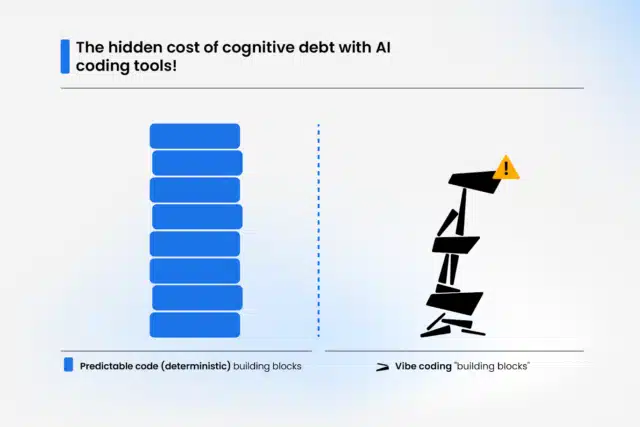
The promise of vibecoding is huge. Anyone who instructs an AI tool such as Claude to develop a transport or warehouse management system will have a working prototype in no time. But how reliable is that solution? How can you be sure the software does what it’s supposed to do? Those who don’t trust it can turn to suppliers of off-the-shelf software systems, but that may come at the expense of their unique selling points. “It’s run-of-the-mill companies that rely on off-the-shelf software,” claims Ardjan Baan, CEO of Rappit. “Successful companies, on the other hand, rely on software that sets them apart from the run-of-the-mill firms. We have developed a platform with AI agents that enables companies to outperform their competitors in the way they operate.”
Customisable and independent
Baan tells his story at De Vanenburg Castle, where Rappit is introducing a new development platform featuring Agentic AI technology. The leading role in this story is played by Rai, the AI agent that helps companies develop their own software solutions with the aid of the Rappit platform. The result is a solution that is adaptable, context-aware, agentic and autonomous. “Companies and processes are constantly changing. Their solutions must therefore also be able to change,” says Baan, explaining the requirement for adaptability. “By ‘context-aware’, we mean that solutions must be based on best practices within the companies and must enable data-driven decisions.”
‘Agent-based’ refers to the use of AI agents that can act and make decisions independently. “Suppose your stock level reaches a certain point or your supplier calls. An AI agent must be able to act on your behalf, make suggestions and take action,” explains Baan. “And perhaps most importantly: the solution must be autonomous. We want companies to own the solution themselves and have full control over the software, data and working methods. All within the safety net put in place to ensure they can operate securely and reliably. Rappit’s customers therefore only pay for the use of our platform, not for the software they develop using it.”
From freight train to intelligent platform
According to Johan den Haan, who is responsible for product strategy at Rappit, many companies use outdated business software that can best be compared to a freight train. “They are stable and can handle a great deal, but they aren’t fast and cannot deviate from the tracks. Standard software suppliers can offer you an upgrade and perhaps even a cloud solution. Then you’ll have a new train that’s more modern and faster, but still follows the old tracks,” explains Den Haan. “The alternative is vibecoding, but that results in a drone rather than a train. It may be flexible and manoeuvrable, but is it powerful enough for your business operations? And does it comply with all laws and regulations?”
Rappit has sought to combine the best of both solutions. “If you choose to develop a solution yourself, you don’t want to start completely from scratch, but instead build on existing knowledge and experience. You want to be able to deploy AI agents, but in a safe and controlled manner,” explains Den Haan. “Finally, you don’t want to create a solution that will be obsolete by next week, but one that will last for decades. That means the software must be able to grow with you.”
Rai keeps the blueprint alive
Rai provides support for this. Prior to developing a new solution, for example, this AI agent analyses the existing IT landscape to gain an understanding of business operations. Rai can independently gather information from stakeholders and incorporate this into the blueprint for the new solution. Furthermore, Rai keeps the blueprint up to date, even when there are changes to the software’s visual interface or to the software code itself. At a later stage, users can always look up the reason behind a particular change.
Once the blueprint is ready and the software code can be written, the AI draws on the expertise that Rappit and the Baan family’s previous software companies have built up over the past 48 years. Rai then directs a swarm of AI agents, each of which takes responsibility for different parts of the solution. “If necessary, Rai makes it possible to make manual adjustments to the software. For example, by modifying the business logic or the data model,” explains Den Haan. “Once the solution is ready, Rai can set up the functional tests. And as mentioned, companies become the full owners of the developed solution.”
Planning tank containers
Companies such as Hunkemöller, Omoda, Solvay and Valeo are already using the Rappit platform. “One of our clients is NewPort, a global logistics service provider specialising in tank containers. They were using a standard TMS, but it didn’t quite fit in with their unique way of working,” explains Baan. “NewPort discussed the development of additional functionality with the TMS supplier, which would then become available in the standard solution after a long wait. This had two consequences: the software would become more valuable and therefore more expensive, whilst the additional functionality would also become available to competitors.”
Using the Rappit platform, NewPort has now developed its own custom TMS for planning, booking and tracking all shipments. The result is a solution that has significantly automated and accelerated these processes. “Furthermore, we have developed an additional solution which, based on data and using smart AI, predicts when and where tank containers will be needed. This forecast helps NewPort to respond more effectively to seasonal patterns and optimise transport flows,” explains Baan. “We have also developed an AI agent that automatically contacts transporters to retrieve information on rates.”
Verhoek Europe processes documents eight times faster
Another client is Verhoek Europe, the logistics service provider based in Genemuiden that primarily stores and transports rolls of carpet. Verhoek Europe has engaged Rappit not only to develop a custom TMS, but also to create an integrated AI agent. “Following Brexit, they saw a massive increase in the volume of paper documents, which led to additional manual tasks. The new AI agent scans, reads, interprets and processes all documents. This involves more than 100,000 documents a year, which they can now process eight times faster. The payback period for this agent was less than three months,” says Baan.
Companies need not worry that these solutions will be made available to other Rappit clients. “As mentioned, the intellectual property remains with the client. They own the solution and decide what happens to it,” explains Baan. “So it’s not the case that we train our own AI models using solutions from NewPort or Verhoek Europe. What we do, however, is make available nearly fifty forty years’ worth of knowledge and experience in the development of business software. This covers fundamental elements such as the management of user roles and users, security and encryption, and integrations with other systems. We incorporate that knowledge into our AI models.”