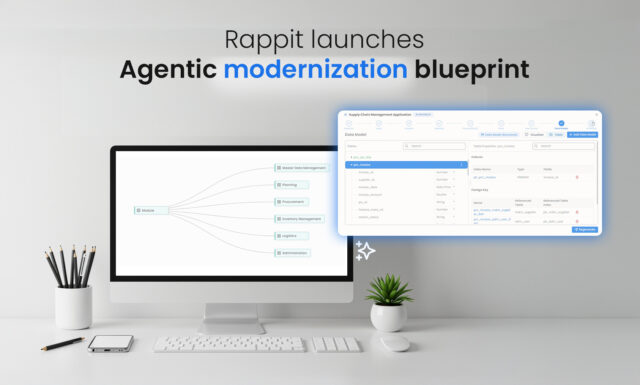
Legacy modernization with Agentic AI: Transform core systems in months, not years

How legacy systems kill your competitive advantage
Legacy systems were never supposed to become anchors. Years ago, when your mainframe, custom ERP, aging CRM, or mission-critical core system was installed, it was a strategic investment, built for reliability and tailored for your unique operational needs. It worked.
But nothing lasts forever.
Today, that same legacy system has become a silent saboteur. It drains productivity through manual processes and fragmented data. It drives away talented developers who refuse to maintain COBOL or AS/400, exposes your organization to security threats it was never designed to withstand, and paralyzes your competition strategy; trapping you in multi-year modernization cycles while competitors move in months. And beneath the myth of “cheap maintenance” lie higher operational expenses, vendor lock-in, and the crushing opportunity cost of what you can’t build.
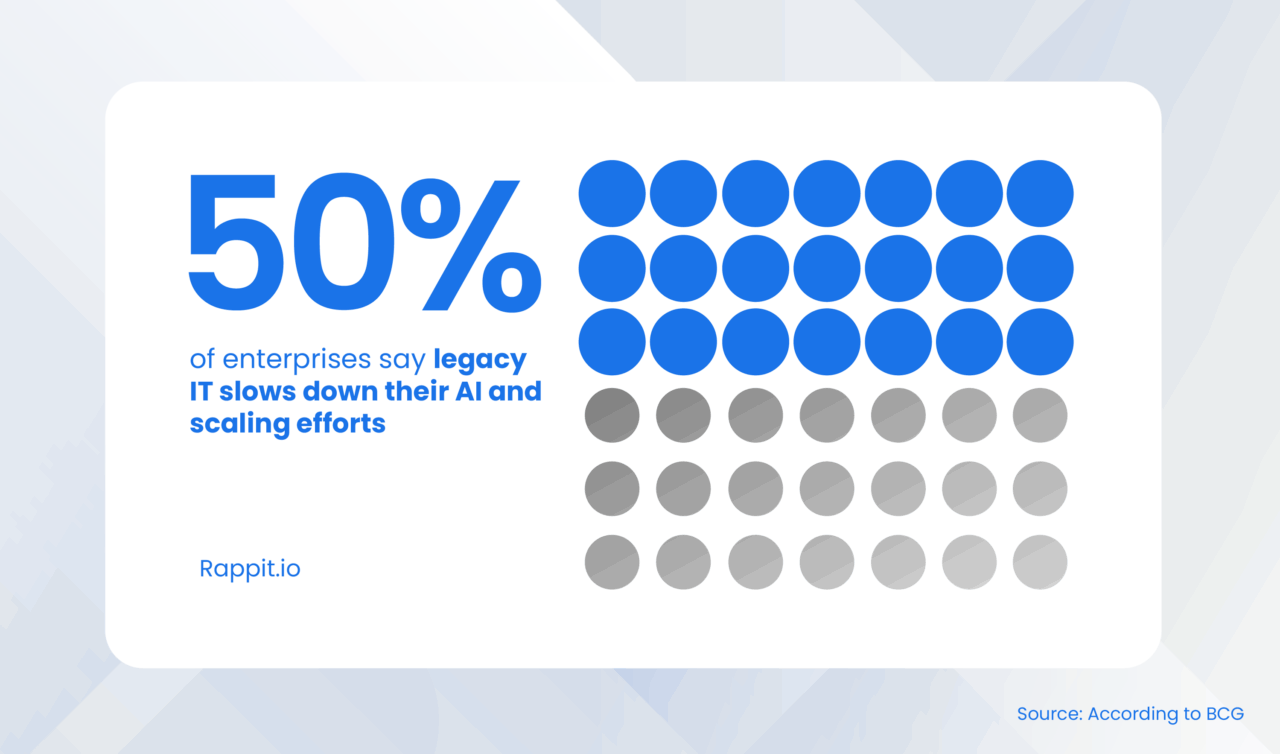
You’re not alone. According to BCG, over 50% of enterprises believe legacy IT systems are actively slowing down their ability to scale, reuse infrastructure, and leverage data for AI-driven initiatives. Legacy isn’t just a technical problem anymore. It’s a competitive liability.
Why traditional modernization fails
The conventional approach is to rip out the old system, build the new one, and go live.
In practice, this fails catastrophically. Executives see the €10M price tag and kill the project before it starts. The operational risk paralyzes decision-makers. Your legacy system has been shaped by 20 years of undocumented business decisions. Your team knows the old system, but not cloud-native architecture or AI-powered design.
The result: enterprises either sink deeper into technical debt or attempt a costly, multi-year rip-and-replace that burns budgets and burns out teams. Neither path works.
There’s a better way: AI-led, de-risked modernization
What if modernization didn’t require betting the company?
What if, instead of spending months manually reverse-engineering legacy code and wrestling with undocumented business logic, agentic AI could extract the intent, with precision, from your systems in minutes?
What if you could deliver modern, secure, scalable applications in minutes instead of months or years, with full visibility, full control, and reduced risk every step of the way?
That’s what Rappit’s Agentic modernization blueprint delivers: AI-led legacy discovery and transformation for any core system.
The challenge: Legacy discovery
Your legacy system holds years of business logic, workflows, data relationships, and rules. But where is it documented? In someone’s head who left the company. In code that nobody understands or wants to work with anymore.
Modernization starts with a bottleneck: reverse-engineering. Developers spend weeks or months trying to understand what data the system manages, how business logic flows, what the critical workflows are, and which rules must be preserved. This manual work is slow, error-prone, expensive, and the same for every type of core system.
The solution: Agentic modernization blueprint
Agentic modernization blueprint is Rappit’s AI-led intelligent legacy discovery and transformation engine for any core system.
Here’s how it works. You upload what you have: functional application documentation in PDF or application screenshots; whatever assets exist for your legacy system. You don’t need perfect documentation. Agentic modernization blueprint is designed to work with real enterprise data in all its messy, undocumented glory.
IT teams report 50% to 70% time savings on application blueprint development. What used to take 2 to 3 months of manual reverse-engineering is now delivered in weeks.
Agentic AI, powered by Google Cloud’s Vertex AI and Gemini models, then analyzes your assets and intelligently extracts the intent, with precision, behind your legacy system. This is the critical difference. AI doesn’t just convert code (which simply moves your tech debt to a new platform). It extracts why your system works the way it does, enabling true modernization, not just migration.
Your team validates and reimagines. Every AI suggestion comes with full transparency and traceability. You validate, accept, reject, or optimize each component. This isn’t a black-box transformation. It’s a guided journey where you stay in control.
Reimagining business processes
Here’s where the Agentic modernization blueprint becomes truly transformative: it doesn’t just modernize your systems. It enables you to reimagine your business processes alongside them.
System modernization without process reimagination is incomplete. Modernizing your technology while keeping 20-year-old workflows intact is like upgrading an engine without redesigning the vehicle around it. The agentic modernization blueprint aligns both transformations. Your team rebuilds core systems and reimagines the processes they support in the cloud. The result is truly future-ready enterprise applications, built on modern, cloud-native architecture without the baggage of outdated technology or processes.
The tangible value
IT teams report 50% to 70% time savings on application blueprint development. What used to take 2 to 3 months of manual reverse-engineering is now delivered in weeks. Your team gets a solid, AI-generated foundation ready for customization and deployment, freeing developers to focus on innovation and value delivery, rather than reconstruction.
The agentic modernization blueprint automatically generates roles, data model table entities, user stories, and pages from legacy inputs. Business users and developers easily adjust AI-discovered models to reflect actual business requirements before components are generated. Vector indexing enables incremental suggestions across the development lifecycle as business needs evolve.
The output is enterprise-ready: production-ready application components structured for cloud-native, microservices-based deployment and designed for AI integration and continuous evolution.
For years, legacy modernization was viewed as a necessary evil. Complex, high-risk, and driven by technical debt reduction. AI has fundamentally changed this equation. With Agentic modernization blueprint, enterprises can now transform outdated systems into future-ready, cloud-native applications faster, with less risk, and without simply moving their technical debt to a new platform.
Ardjan Baan, CEO of Rappit
Build for continuous evolution
Here’s the real breakthrough: The agentic modernization blueprint isn’t just about modernizing what you have. It’s about preventing legacy from happening in the first place.
With AI-led development built into Rappit’s platform, your modernized applications are designed for continuous evolution. Your team can adapt to changing business needs in weeks, not months. No more multi-year cycles. No more technical debt accumulation. Legacy modernization isn’t a one-time project. It’s the beginning of a continuously modern, AI-ready enterprise.
Start your modernization today
As Ardjan Baan, CEO of Rappit, says: “For years, legacy modernization was viewed as a necessary evil. Complex, high-risk, and driven by technical debt reduction. AI has fundamentally changed this equation. With Agentic modernization blueprint, enterprises can now transform outdated systems into future-ready, cloud-native applications faster, with less risk, and without simply moving their technical debt to a new platform.”
Whether you’re modernizing your ERP, CRM, WMS, or any mission-critical legacy system, your transformation journey starts today. Agentic modernization blueprint gives you the speed, control, and confidence to rebuild on modern architecture designed for AI and continuous evolution.
Legacy modernization as a competitive advantage
Legacy systems are now competitive liabilities. 50% of enterprises say legacy IT slows down their AI and scaling efforts. Traditional modernization is too slow, too risky, and too expensive. Agentic modernization blueprint accelerates legacy discovery by up to 70%, extracting intent, with precision, not just code.
In months, not years, you get a modern, cloud-native, microservices-ready application foundation. And through continuous AI-led evolution, your modernized applications stay agile and competitive. True digital transformation begins with intelligent legacy modernization.
Not just migration, but competitive advantage.