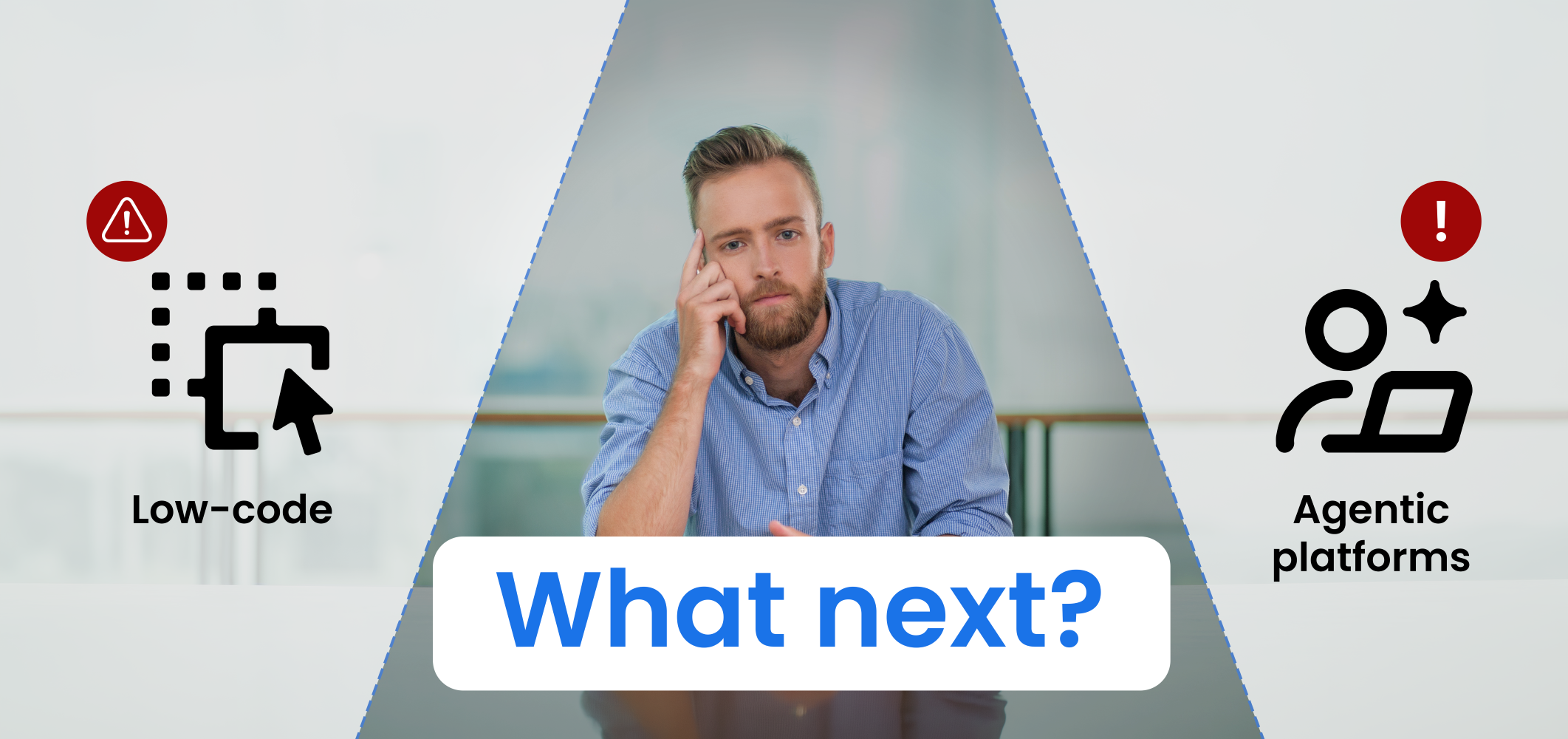
Low-code is the past. Agentic platforms won’t suffice. Now what?

Why enterprises need a new way to build
For the past decade, enterprise software has been chasing the same promise in different forms. Low-code promised better software, built faster. Agentic platforms say software will build itself.
Neither is built to solve what’s next for enterprise software development in the age of agentic AI.
The future isn’t just about generating code and software faster. It’s about fundamentally changing how mission-critical core systems are imagined, built, and owned.
Low-code and agentic platforms are both dead ends for enterprises looking to build future-ready software. Here is why.
What limited low-code
Low-code platforms weren’t built for the agentic world we’re entering. They were built for the world we’re leaving behind.
These platforms were designed before AI became central to software development. Built on yesterday’s technology. AI was added on top after the fact, usually as a separately priced feature, or a loosely integrated assistant; not as the foundation. That matters.
When AI is bolted onto a development lifecycle that was never designed for it, you don’t get a new way. You get the old model dressed up with AI. A limited edition with a fast-approaching expiration date.
Low-code promised better applications, built faster, but it never delivered for enterprises building custom core systems. What it did deliver was vendor lock-in and code that professional developers couldn’t extend.
The result was applications that inherited the constraints of the platform rather than the flexibility of code. High-volume transactions created bottlenecks and performance hit a ceiling. When you pushed beyond those limits, the cracks appeared quickly.
Customization became disproportionately expensive. The last 20%, where real differentiation lives, still took the majority of the effort. Developers were forced to work around the platform, often introducing complexity that was harder to manage than building from code in the first place.
Vendor lock-in made it worse. Enterprises became heavily dependent on a single vendor’s platform and suffered excessive licensing increases as a result. In an AI-led world where code generation is the expected default, that dependency is a liability.
Rappit saw this coming. From day one, we built an open development platform that generates Java code for enterprise applications.
Not bolted on. Built-in.
Where agentic platforms fall short
Agentic platforms take the opposite approach to low-code. Instead of abstracting development, they try to automate it entirely using agents.
They are AI-native. They collapse the gap between idea and implementation. Vibe coding platforms make it possible to go from intent to working websites and small applications in minutes.
That’s a real breakthrough, but it introduces a different set of problems when you move beyond prototypes and into advanced enterprise applications.
The first is collaboration. Most agentic platforms are designed around one person, one agent, one task. That works well for isolated productivity, but it breaks down when you try to build and evolve complex systems with large teams.
Core systems are not built by individuals. These systems are built by business analysts, designers, developers and architects, all contributing different perspectives and competing requirements over time. Agentic platforms don’t support that complexity. They generate outputs without a stable layer connecting them back to the business intent.
The second problem is understanding. When software is generated through prompts and AI agent interactions, the “why” behind it becomes fragmented. It works initially, but no one understands how or why. That’s an acceptable risk for small applications. It’s a serious risk for core systems that need to run for years and evolve with the business.
Third is reliability and maintainability at scale. Agentic platforms generate code fast, but humans can’t keep up. Validation becomes impractical. Debugging becomes an exercise in interpreting AI behavior. And just like with low-code, the last 20% becomes the hardest part, except now it’s buried inside layers of AI generated code. That’s not progress.
Finally, governance and control. Enterprises need core systems they can depend on. Their business depends on it. That requires an enterprise-grade foundation.
Agentic platforms push autonomy, which is powerful in theory but dangerous without guardrails. Agents left unchecked have already caused serious damage at companies like Amazon.
AI agents can automate tasks, but they don’t solve the harder problem: how to build and evolve core enterprise systems in collaboration with human teams, without creating tomorrow’s legacy and AI-induced technical debt.
In the age of agentic AI, the biggest risk is moving fast in the wrong direction.
The new way to build
The next wave of enterprise development isn’t about faster code. It’s about a fundamentally different way of building, where human intent drives every decision, teams and AI work as one, and core systems are built to evolve.
The future is released soon and it looks like this:
- Human intent at the center. Not just faster execution, but genuine creative insight driving application generation, with business and IT aligned around what they’re building and why.
- Truly human-AI collaborative. Bigger development teams, human and AI teammates alike, working together in a single, governed flow.
- Enterprise and future-ready. Intelligent core systems that stay open, adaptable and governed, instead of solidifying into new legacy.
At the heart of that future sits Rai, Rappit’s AI companion, built for enterprise software teams who refuse to choose between speed and control.
Rai brings the power of an entire software development team to your fingertips, guided by human intent and built to scale and evolve with your business, without creating tomorrow’s legacy. Nothing like it exists yet!
The new way to build is here.
The new way to build
The only next-gen agentic development platform built for enterprise with custom core systems, business applications and AI agents, all native on one foundation.
Secure. Governed. Scalable.